
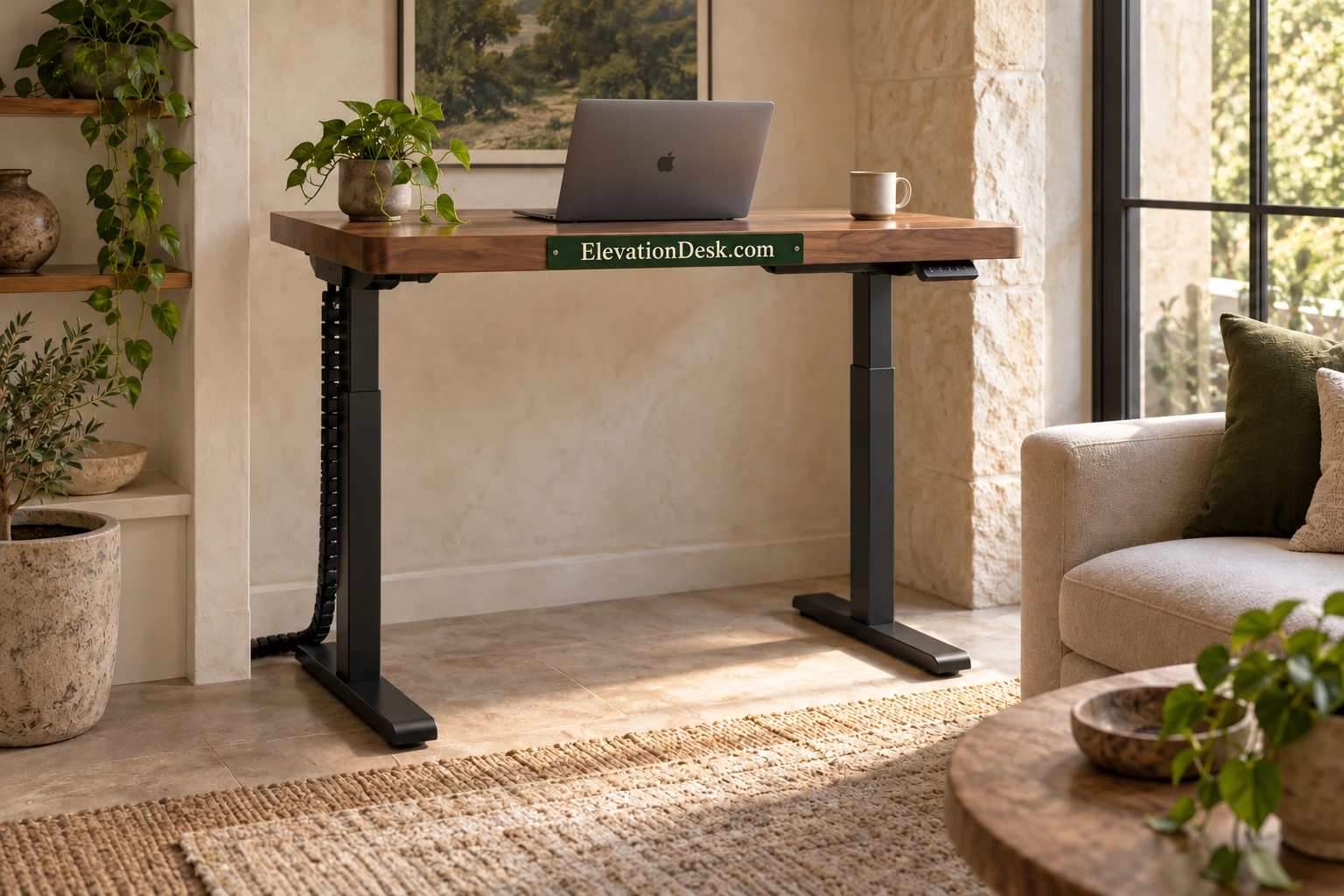
Some rooms become an office for part of the day and a living space for the rest of it. In those rooms, a desk has to fit both physically and visually. ElevationDesk.com could become a compact adjustable furniture collection that starts with those limitations. The concept below is illustrative: an acquirer would need to design, source and support the actual products.
Define the room before defining the catalog
A useful first customer might work in a bedroom corner or a living room alcove and use one monitor with a laptop. This person needs a desk that accommodates equipment without making the room feel devoted entirely to work. A compact collection should therefore begin with room measurements and routines rather than a general promise to fit any small space.
Interview people who use these shared-purpose rooms. Ask what happens to the chair when work ends, which items must stay within reach and whether the desktop is visible from the room’s main seating area. A narrow surface is not a complete solution if the chair blocks a wardrobe or the power lead runs across a walkway.
Make a small product range purposeful
The first range could offer a compact surface in a few restrained finishes, on a frame verified for that surface. The base dimensions matter as much as the top. A smaller desktop fitted to a wide base may fail the room constraint that led the customer to choose it.
Accessories should support the shared-use room. A tray may organize leads underneath, and a removable accessory can be useful when the owner wants a simpler surface at the end of the day. The business should evaluate these combinations with real equipment and actual cables. A styled photograph with no visible power connection cannot demonstrate how the arrangement works.
The customer needs exact dimensions and clear images from several angles. Show the desk at seated and raised positions, including the controls and the space behind the top. A room view can communicate scale, but it should accompany a dimensioned diagram rather than replace it. Customers should not have to estimate size from a plant or an unfamiliar chair.
Keep equipment fit honest
A compact collection should specify the setups it has tested and the limits of those examples. A surface that works for a laptop may feel crowded with a deep monitor stand. A clamped arm can free surface area, but its compatibility depends on the desk edge, the monitor and the arm itself.
OSHA’s monitor guidance is useful context for arranging equipment in front of the user. That does not mean one small desk fits everyone. The brand can help buyers compare equipment depth with the available surface and direct them to actual product specifications. Avoid advertising compactness in a way that encourages customers to ignore the rest of the workstation.
Prototype two different room layouts
An illustrative prototype test could use the same desk in two rooms. The first is an alcove with a nearby outlet and a door opening toward the desk. The second is a bedroom with a wardrobe behind the chair. Neither room needs to look like a showroom; the point is to see what the desk changes during ordinary use.
In each room, the tester measures the base, chair movement and cable path. They move the desk through its intended range and check whether any accessory meets the wall or adjacent furniture. They then return the room to its nonworking arrangement. If the chair has nowhere to go or the cables remain conspicuous, the product or guidance needs another iteration.
The business should document what the prototype does well and what it does not support. A compact furniture brand becomes more useful when it helps a customer rule out an unsuitable option. That may lead to fewer immediate orders, but it also prevents a product from arriving in a room where it cannot reasonably work.
Reach buyers through room-planning help
A practical distribution route is content organized around common room layouts. Demonstrate how to measure an alcove, compare a desktop with a monitor stand and identify the space needed behind a chair. These topics reach people already trying to solve a furniture problem and give the collection a reason to appear in their search.
Partnerships with interior designers or compact-living publications could introduce the products to relevant readers. Any supplied-product or paid relationship needs clear disclosure. The product should be photographed in complete rooms with normal equipment, and the business should label demonstrations accurately before it has real customer installations to share.
Plan for packaging and support
Compact does not mean easy to ship. A finished surface still needs protection, and cartons must contain the correct components and usable assembly instructions. The founder should have someone unfamiliar with the prototype assemble a representative package. That test can expose ambiguous steps and parts that are difficult to identify.
Returns, spare components and finish variations also need a process. A customer choosing furniture for a living space may care closely about color and texture. Describe the material honestly, distinguish a veneer or finish from solid timber and explain normal variation where applicable. Samples can help, but they do not replace accurate photographs and descriptions of the actual product.
Learn before widening the collection
The first milestone is a prototype that works in two genuine room layouts and a clear comparison guide that helps buyers evaluate their own space. Collect specific feedback on equipment placement, daily transitions and assembly. Revise the product or positioning before adding more finishes and accessory bundles.
ElevationDesk.com could give this compact collection a direct identity within the adjustable furniture category. It leaves the actual range and visual direction to the acquiring company. To discuss the domain, send a Buyer inquiry describing the planned collection, or outline a partnership proposal with the operational resources behind it. The domain-only offer includes none of the illustrative furniture described here.